Kitchen Benchtop Caulking Guide: Where and How to Seal Joints
The small joint where your kitchen benchtop meets the splashback, wall, sink or surrounding surfaces can make a big difference to how your kitchen performs over time. If that junction is not sealed properly, water, grime and mould can build up, and movement between materials can cause cracking or failure. In this guide, we explain where to use caulking or silicone around kitchen benchtops, which type is usually best, and what mistakes to avoid.
Key takeaways
- Silicone is commonly used where the benchtop meets a splashback, wall or another material.
- These joints need flexibility, so silicone is usually more suitable than rigid grout.
- Neutral-cure silicone is often preferred around some natural stone surfaces such as marble.
- A clean, dry surface and correct tooling are essential for a neat, long-lasting finish.
Why kitchen benchtop joints need sealing
Kitchens are wet, messy and high-use environments. Water from sinks, splashes from cooking and cleaning products can all work their way into open or failing joints if the gap between surfaces is not sealed properly.
Sealing these junctions helps:
- Reduce water infiltration
- Keep food residue and grime out of gaps
- Allow for slight movement between surfaces
- Create a cleaner finished look
Where to use silicone around a kitchen benchtop
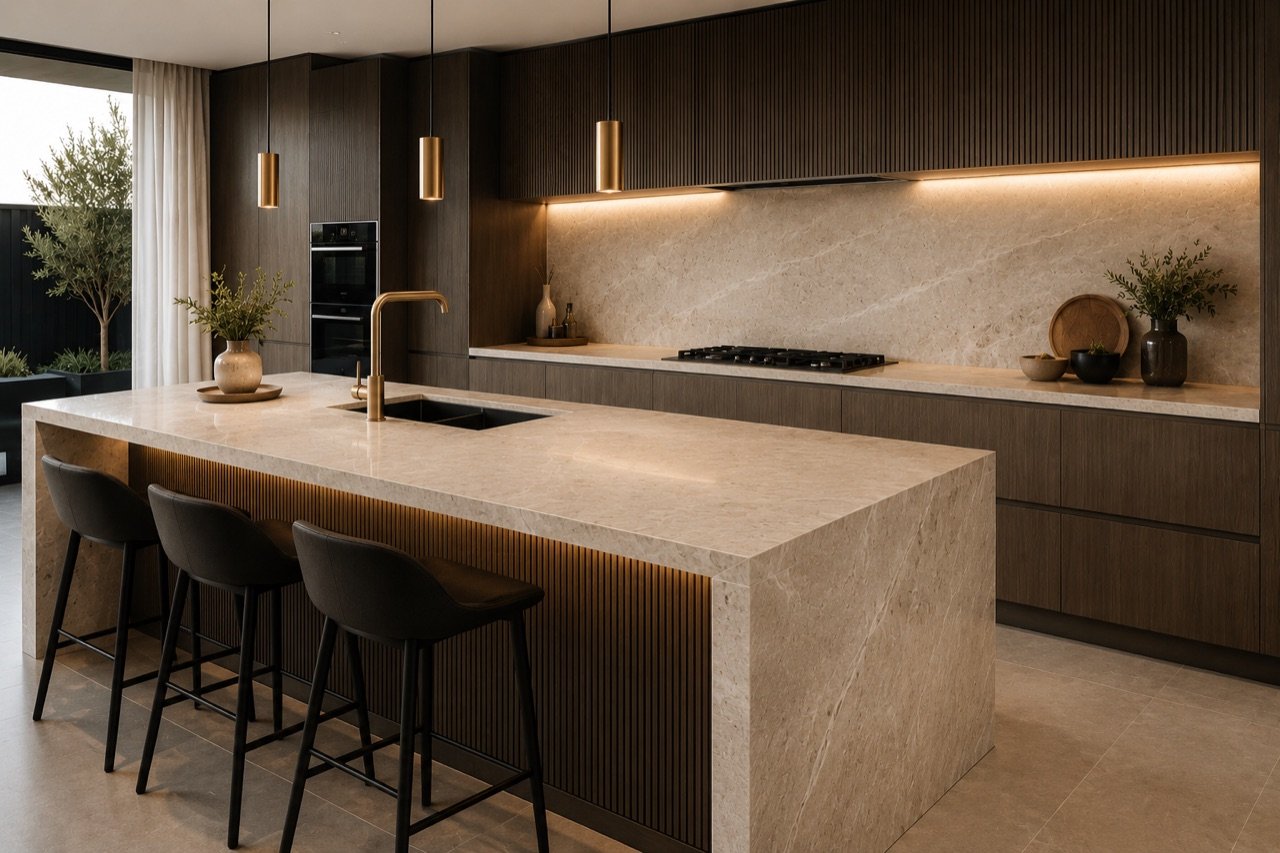
Silicone is commonly used in these kitchen locations:
- Between the benchtop and tiled splashback
- Between the benchtop and glass or acrylic splashback
- Where the benchtop meets the wall
- Around sinks and some cut-out penetrations
- At small transition joints between different materials
These are all places where a tight, flexible, water-resistant joint is more important than a rigid finish. For the same principle applied more broadly across bathrooms and showers, see our When to Use Caulking vs Grout guide.
Should you use grout or silicone between the benchtop and splashback?
In most cases, silicone is the better choice for the joint between a benchtop and splashback. That junction can move slightly over time because the wall, cabinetry and benchtop are different materials and do not always move exactly the same way.
Grout is rigid and is more likely to crack in that kind of joint. Silicone is flexible, which makes it better suited to this type of transition.
What type of silicone is best?
Wet-area or kitchen-grade silicone
In most kitchens, a quality wet-area or kitchen-grade silicone is the usual starting point. These products are designed to resist water and everyday household exposure.
Neutral-cure silicone
Neutral-cure silicone is often the safer option around some sensitive surfaces, particularly softer natural stones such as marble. Some guidance also recommends neutral-cure silicone for certain splashback and cladding systems.
Acid-cure silicone
Acid-cure silicone is commonly used in many general kitchen sealing jobs, but it is not always suitable for every surface. On some natural stone materials, especially marble, there is a risk of staining or reaction, so checking compatibility first is important.
How to choose the right silicone colour
In many kitchens, the cleanest look comes from matching the silicone either to the benchtop, the splashback or the grout line colour. Grey tones are often popular because they hide dirt better than bright white and work with a wide range of surfaces.
White can look crisp at first, but it often shows dirt, grease and ageing more quickly in busy kitchen zones.
When to avoid using grout
Grout is generally not the best choice for joints where:
- The benchtop meets a wall or splashback
- Two different materials meet
- There is likely to be minor expansion, contraction or movement
- The joint needs waterproof sealing rather than a rigid fill
Grout still has an important role within tiled surfaces, but transition joints are usually a flexible-sealant job.
Basic steps for caulking a benchtop joint
Exact methods vary by product, but the general process is usually:
- Remove any old or failed silicone completely.
- Clean the joint thoroughly and let it dry fully.
- Mask the edges if you want a sharper finish.
- Cut the nozzle at an angle to match the bead size needed.
- Apply a steady bead of silicone into the joint.
- Tool the bead smooth with a suitable tool or method.
- Allow the silicone to cure before heavy water exposure.
A neat finish depends heavily on good prep. Dust, grease, soap residue and moisture are common reasons silicone fails early.
Common mistakes to avoid
- Applying silicone over dirty surfaces: this reduces adhesion.
- Leaving old silicone behind: new sealant bonds best to clean, properly prepared joints.
- Using grout where movement is expected: the joint may crack.
- Choosing the wrong cure type for stone: some surfaces need neutral-cure silicone.
- Using too much water during tooling: this can affect the finish if overdone.
- Getting the kitchen wet too soon: cure time matters.
How long does kitchen silicone last?
A well-applied silicone joint can last for years, but lifespan depends on exposure, cleaning habits, movement and product quality. Areas behind sinks or directly behind food prep zones may wear faster than drier sections.
If the silicone becomes mouldy, cracked, detached or shrunk away from the surfaces, it is usually time for replacement rather than patching.
Signs a benchtop joint needs replacing
- Silicone is peeling away from the wall or benchtop
- There are cracks or splits in the bead
- Water is getting behind the splashback or into the gap
- The joint is heavily mouldy or permanently discoloured
- The finish looks rough, patchy or incomplete
What about stone benchtops?
Stone benchtops need extra care when selecting sealants and cleaners. Some natural stones are more sensitive than others, and incompatible sealants or harsh cleaning products can stain or damage the surface.
For marble and other softer or more absorbent stones, neutral-cure silicone is often the safer option. Granite is usually more forgiving, but product compatibility still matters. See our Natural Stone Benchtop Care and Maintenance guide for daily care of these surfaces.
When to call a professional
Benchtop and splashback joints may look simple, but poor sealing can lead to moisture issues, mould, ugly finishes and repeated repairs. This is especially true if the kitchen includes natural stone, premium splashback materials, uneven walls or older silicone that needs full removal.
TN Stone provides tiling, stonemasonry, splashback installation and sealing advice across Melbourne and the western suburbs, including Brookfield, Werribee, Caroline Springs, Footscray and surrounding areas.
Need help sealing a kitchen benchtop or splashback properly? Get a free, no-obligation quote from TN Stone.
Request a Free QuoteFrequently asked questions
Should I use grout or silicone between a benchtop and splashback?
In most cases, silicone is the better choice because that joint needs flexibility and water resistance.
What type of silicone is best for kitchen benchtops?
A quality kitchen or wet-area silicone is usually suitable, and neutral-cure silicone is often preferred around sensitive stone surfaces like marble.
Can I silicone over old silicone?
It is usually better to remove the old silicone first. New sealant adheres best to a clean, dry and properly prepared joint.
How long should silicone cure before using the kitchen?
Cure time depends on the product, but it is important to follow the manufacturer's instructions and avoid heavy water exposure too early.
Why is my kitchen silicone turning mouldy?
Mould can develop when moisture, food residue and poor ventilation combine, especially if the silicone is ageing or difficult to keep clean.